Thursday, January 10, 2008

Queen Elizabeth Hotel
Fairmont The Queen Elizabeth (commonly called The Queen Elizabeth Hotel; French: La Reine Elizabeth) is a grand hotel in Montreal, Quebec. It was built by the Canadian National Railway, but was later sold to Canadian Pacific Hotels, now Fairmont Hotels and Resorts.
Located at 900 René Lévesque Boulevard West, in the heart of Montreal, it is connected to Gare Centrale and to the underground city.
Many famous guests have stayed there, including Queen Elizabeth II and the Duke of Edinburgh, the Queen Mother, Prince Charles, Charles de Gaulle, Indira Gandhi, Jacques Chirac, Nelson Mandela, the Dalai Lama, Mikhail Gorbachev, Jimmy Carter, Henry Kissinger, Perry Como, Joan Crawford, John Travolta, and Mikhail Baryshnikov.
The hotel reached worldwide fame when John Lennon and Yoko Ono, who had been refused entry into the United States, conducted their Bed-In and recorded the song Give Peace a Chance in Room 1742 at the hotel, between May 26 and June 2, 1969.
The NHL Entry Draft was also held at the hotel ten times between 1963 and 1979.
The French name, Le Reine Elizabeth, may appear startling because of the use of the masculine article le. The article does not apply to the feminine noun Reine, but to the masculine noun Hôtel.

Wednesday, January 9, 2008

Wolverhampton Varsity
The Varsity chain of forty bars is owned and operated by Barracuda Group in Marlow in Buckinghamshire. It is marketed towards students, usually located near university campuses in British cities — as such, it is a direct competitor of Mitchells and Butlers' Scream brand. Part of the chain is notable for changing its name on multiple occasions. Some Varsity bars were originally known as Springbok and then latterly became Barracuda and following this had became Varsity as it is known today. Barracuda bars were known as Springbok, where there was a South African theme, which is still retained by the Barracuda chain of bars.
The chain offers a discount card known as a V Card, which offers a 25% reduction on drinks, as well as other drinks promotions on certain nights(including £1 Party and 2-4-1) and allows you to have a two for one meal deal (limited number of meals) for £5. Most meals cost at least £4-5.
Few are found in the south of the UK - the only ones are in Cardiff, Reading, Swansea and Southampton.

Wolverhampton Varsity Outlet locations

Aberystwyth
Bangor
Birmingham
Bolton
Bradford
Coventry
Cardiff
Cheltenham
Derby
Durham
Hanley
Huddersfield
Lancaster
Leeds
Leicester (two outlets)
Lincoln
Loughborough
Manchester (two outlets)
Nottingham
Plymouth
Reading
Sheffield (two outlets)
Southampton
Southend
Stirling
Sunderland
Swansea
Walsall
Warwick
Wolverhampton
York

Tuesday, January 8, 2008


There is no undisputed historical depiction of Jesus.
The most common illustration are Christian icons. Images flourished in Medieval art. Most surviving images of Jesus have in common a number of appearance traits which are now almost universally associated with Jesus despite lack of evidence for the accuracy of these depictions.
No detailed physical description of Jesus is contained in any of the canonical Gospels. During the Roman Empire's persecution of Christians, Christian art was necessarily furtive and ambiguous. The earliest surviving Christian art comes from the late 3rd and early 4th centuries on the walls of Christian tombs in the catacombs. Here, and only here, Jesus is portrayed in two different ways: older, bearded and robed and another as a bare faced youth holding a wand. He uses the wand to change water to wine, multiply the bread and fishes, and raise Lazarus. When pictured healing, he only lays on hands. The wand is thought to be a symbol of power. The bare faced youth with the wand may indicate that the Jesus was thought of as a user of magic or a wonder worker by some Early Christians.
There is also the Shroud of Turin, which appears in history in 1353 and which some have speculated is the same image as the Mandylion of Edessa, which disappeared in the wars surrounding the fall of the Byzantine Empire shortly before then. Controversy still surrounds the claims made for the Shroud of Turin.
There are also icon compositions of Jesus and Mary that are traditionally believed by many Orthodox to have originated in paintings by Luke the Evangelist.

Christian depiction of Jesus

Main article: Alexamenos graffito Alexamenos graffito
Conventional depictions of Christ include:

Theotokos images (mother and child)
Baptism of the Lord
Crucifixion
Descent from the Cross
Pieta (mother and dead son)
Resurrected Christ
Lamb of God
Christ Pantokrator
Last Judgement Unconventional depictions
Several Hadith quote Muhammad describing Isa (the Islamic name of Jesus) as he appeared in a dream, and during Muhammad's ascension to Heaven:
"While I was sleeping, I saw myself (in a dream), performing Tawaf (circumambulation of the House of God in Makkah). I saw a reddish-white man with lank hair, with water dripping from his head, I asked, "Who is this?" They replied, "The Son of Maryam (Mary)..." (Bukhari, Muslim)
"Narrated Abdullah: The Prophet mentioned...While sleeping near the Ka'ba last night, I saw in my dream a man of brown color the best one can see amongst brown color and his hair was long that it fell between his shoulders. His hair was lank and water was dribbling from his head and he was placing his hands on the shoulders of two men while circumambulating the Kaba. I asked, 'Who is this?' They replied, 'This is Jesus, son of Mary.'" (Bukhari 4:55:649)
"Narrated Salim from his father: No, By Allah, the Prophet did not tell that Jesus was of red complexion but said, "While I was asleep circumambulating the Ka'ba (in my dream), suddenly I saw a man of brown complexion and lank hair walking between two men, and water was dropping from his head. I asked, 'Who is this?' The people said, 'He is the son of Mary.'" (Bukhari 4:55:650)
"Narrated Abu Huraira: Allah's Apostle said, "On the night of my Ascension to Heaven...I saw Jesus who was of average height with red face as if he had just come out of a bathroom." (Bukhari 4:55:607)

Jesus in Islam
Jesus as the Good shepherd. Ceiling of S. Callisto catacomb, mid 3rd century.
A representation of Jesus as the sun-god Helios/Sol Invictus riding in his chariot. Mosaic of the 3rd century on the Vatican grottoes under St. Peter's Basilica.
Mural painting from the catacomb of Commodilla. One of the first bearded images of Jesus, late 4th century.
Depiction of Jesus in St. Catherine's Monastery in Sinai, 6th century.
An image of Jesus as a medieval knight bearing an attributed coat of arms devised by officers of arms based on the Veil of Veronica
Jesus depicted on an early 8th-century coin.
This 11th-century portrait is one of many images of Jesus in which a halo with a cross is used. Such depictions are characteristic of Eastern Orthodox iconography. Characteristically, he is portrayed as similar in features and skin tone to the culture of the artist.
A 13th century Byzantine mosaic of Christ from Hagia Sophia, Constantinople.
An traditional Ethiopian depiction of Jesus and Mary with distinctively "Ethiopian" features.
The Baptism of Christ, by Piero della Francesca, 1449.
Jesus, aged 12, teaching the doctors of the Faith, painted by José Ribera.
Images of Jesus A Chinese depiction of Jesus and the rich man, from Mark chapter 10.
A mural depicting the baptism of Jesus in a typical Haitian rural scenery, Cathédrale de Sainte Trinité, Port-au-Prince, Haiti.
Sister Faustina's representation of Jesus of Divine Mercy
The Diving Mercy painting by Adolf Hyla (1943).The polish writing at the bottom means "Jesus I trust in you"

Sculpture

Race of Jesus
Iconography
Salvator Mundi
Christ the Redeemer (statue)
Christ the Redeemer (icon)
The Last Supper (Leonardo)
Michelangelo's Pietà
Crucifixion
Holy card
Perceptions of religious imagery in natural phenomena

Monday, January 7, 2008

Biography
Born in Norristown, Pennsylvania, Boyle later moved to nearby Philadelphia. He had a brief scene as the manager of an indoor shooting range in the critically acclaimed 1969 film Medium Cool, filmed in Chicago.

Early life and career
His first starring role was as the title character in the 1970 movie Joe, in which Boyle played a bigoted New York City factory worker to wide acclaim. The film's release was surrounded by controversy over its violence and language. It was during this time that Boyle became close friends with the actress Jane Fonda, and with her he participated in many protests against the Vietnam War. After seeing people cheer at his role in Joe, Boyle refused the lead role in The French Connection (1971),

Screen and theater
In 1990, Boyle suffered a stroke that rendered him speechless for six months. After recovering, he went on to win an Emmy Award in 1996 as Outstanding Guest Actor in a Drama Series for his appearance on The X-Files. In the episode, "Clyde Bruckman's Final Repose", he played an insurance salesman who can see selected things in the near future, particularly others' deaths. Boyle also guest starred in two episodes as Bill Church in Lois and Clark: The New Adventures of Superman.
Boyle was perhaps most widely known for his role as the deadpan, cranky Frank Barone in the popular CBS television sitcom Everybody Loves Raymond, which aired from 1996 to 2005. The show was shot in Los Angeles, to which Boyle commuted from his New York City home. He was nominated for an Emmy seven times for this role, but never won (beaten out multiple times in the Supporting Actor category by his co-star Brad Garrett), though fellow co-stars Garrett, Ray Romano, Patricia Heaton, and Boyle's TV wife Doris Roberts won at least one Emmy each for their performances.
In 1999, he had a heart attack on the set of Everybody Loves Raymond. He soon regained his health and returned to the series.
In 2005 and 2006 he made several appearances on the Comedy Central show Mind of Mencia as himself, mostly delivering "cranky old person" one-liners. Show host Carlos Mencia gave a short tribute to Boyle consisting of his most memorable jokes on the show at the beginning of its third season in 2007.

Later life and career
On December 12, 2006, Boyle died in New York City at New York Presbyterian Hospital after suffering from multiple myeloma and heart disease.
At the time of his death, Boyle had completed the film All Roads Lead Home, and was scheduled to appear in the film Chatham.

Death


Nomination (1977) — Lead Actor in a Drama or Comedy Special: Tail Gunner Joe
Nomination (1989) — Guest Actor in a Drama Series: J.J. Killian in Midnight Caller episode "Fathers and Sins"
Win (1996) — Guest Actor in a Drama Series: Clyde Bruckman in The X-Files episode "Clyde Bruckman's Final Repose"
Nominations (1999-2005) — Supporting Actor in a Comedy Series: Everybody Loves Raymond


The cast of Everybody Loves Raymond was nominated for Performance by an Ensemble in a Comedy Series each year from 1999-2000 and 2002-2006. Boyle was additionally nominated for Outstanding Performance by a Male Actor in a Comedy Series in 2002.

Emmy Award
Screen Actors Guild (SAG) Award Awards and nominations

Boyle met Alterman on the set of Young Frankenstein while she was there as a reporter for Rolling Stone. He was still in his Frankenstein makeup when he asked her for a date. Trivia

The Group (1966)
The Virgin President (1968)
Medium Cool (1969)
The Monitors (1969)
Joe (1970)
Diary of a Mad Housewife (1970)
T.R. Baskin (1971)
The Candidate (1972)
F.T.A. (1972)
Ghost in the Noonday Sun (1973)
Steelyard Blues (1973)
Slither (1973)
The Friends of Eddie Coyle (1973)
Kid Blue (1973)
Crazy Joe (1974)
Young Frankenstein (1974)
Taxi Driver (1976)
Swashbuckler (1976)
F.I.S.T. (1978)
The Brink's Job (1978)
Hardcore (1979)
Beyond the Poseidon Adventure (1979)
Where the Buffalo Roam (1980)
In God We Tru$t (1980)
Outland (1981)
Hammett (1982)
Yellowbeard (1983)
Johnny Dangerously (1984)
Turk 182 (1985)
Surrender (1987)
Walker (1987)
The In Crowd (1988)
Red Heat (1988)
The Dream Team (1989)
Speed Zone! (1989)
Funny (1989) (documentary)
Solar Crisis (1990)
Men of Respect (1991)
Kickboxer 2: The Road Back (1991)
Nervous Ticks (1992)
Death and the Compass (1992)
Honeymoon in Vegas (1992)
Malcolm X (1992)
The Shadow (1994)
Killer (1994)
The Santa Clause (1994)
Exquisite Tenderness (1995)
Born to Be Wild (1995)
While You Were Sleeping (1995)
Final Vendetta (1996)
Milk & Money (1996)
That Darn Cat (1997)
Species II (1998)
Dr. Dolittle (1998)
Monster's Ball (2001)
The Cat Returns (2002) (voice in English version)
The Adventures of Pluto Nash (2002)
The Santa Clause 2 (2002)
Bitter Jester (2003) (documentary)
Imagine New York (2003) (short subject)
Scooby Doo 2: Monsters Unleashed (2004)
The Santa Clause 3: The Escape Clause (2006) Peter Boyle Quotes

Thursday, January 3, 2008


Coordinates: 55°01′55″N 1°33′21″W / 55.0318, -1.5557
Killingworth, formerly Killingworth Township, is a town north of Newcastle Upon Tyne, in North Tyneside, United Kingdom.
Built as a planned town in the 1960s, most of Killingworth's residents commute to Newcastle, or the city's surrounding area. However, Killingworth itself has a sizeable commercial centre, strong bus links to the rest of Tyne and Wear, several schools, a medical centre and library, which provide for the town's community. A new leisure centre which contains a 25m swimming pool, gym and sauna opened in May 2007. Killingworth is not on the Tyne and Wear Metro network; .
Nearby towns/villages include Killingworth Village (which existed for centuries before the Township was built), Forest Hall, West Moor and Backworth.

Culture
Construction of Killingworth, a new town, began in 1963. Intended for 20,000 people, it was a former mining community, and was formed on 760 acres of derelict colliery land near Killingworth Village, which had existed since the 18th century and earlier. The building of Killingworth Township was undertaken by Northumberland County Council, and was not sponsored by the Government. It was assigned "New Town" status in the 1960s in a similar fashion to the nearby town of Cramlington.
Unlike that town, Killingworth's planners adopted a radical approach to town centre design, resulting in a development of relatively high-rise buildings in an avant-garde and brutalist style, and won awards for architecture, dynamic industry and attractive environment.
This new town centre consisted of pre-cast concrete houses, 5- to 10-storey flats, office blocks and service buildings, shops, and car parks, interconnected by ramps and walkways. These made up a deck system of access to shopping and other facilities, constructed on the Swedish Skarne method of construction[2]. However, the walkways become dangerous and have since been demolished.
Killingworth in the early 1960s was originally called Killingworth Township, but after 40 years the Township was dropped and everyone calls it Killingworth or Killy.
Around 1964, during the reclamation of the derelict pit sites, a 15-acre lake south of the town centre was created; spoil heeps were levelled, seeded and planted with semi-mature trees. Today, swans, ducks and local wildlife live around the two lakes which span the main road into Killingworth. The lake is kept well stocked with fish and an angling club and model boating club use the lakes regularly.
Building in the western industrial estate, previously British Gas, now North Tyneside Council, 2 May 2006
Killingworth boating lake, 2 May 2006
Carriage formerly used to carry coal south of Killingworth.

History of the Township

Housing
Killingworth originally consisted of local authority houses. The first houses at Angus Close, owned by the local authority, were built to house key workers for the British Gas Research Center. The rest of Killingworth's estates were cul-de-sacs named "Garths" - all numbered, i.e. Garth One, Garth Two, Garth Three etc.
The houses in the Garths were built of concrete and had flat roofs, but around 1995 the Local Housing Association modernised the Garths in West Bailey (the west of Killingworth): they added pitched roofs to the flat-roofed homes, renewed fencing, built new brick sheds, and relocated roads and pathways. Along with this they changed several Garths' names and replaced them with names of lakes, birds and trees. The lowest remaining numbered Garth is Garth Four (the highest is Garth Thirty-Three in East Bailey). Many of the Local Authority Homes have been purchased by the tenants, some of whom still reside in the houses that were built new in the 1960s.

Garths
Killingworth has grown since the early 1960s, with the addition of new privately-owned homes, Highfields Estate was built in the 1970s and was named after battles e.g. Flodden, Agincourt, Stamford, Culloden, etc.

Blocks of flats

Town centre
The first two shops built in Killingworth in the 1960s were Moore's and a small confectionery shop, situated between Garth Six and Angus Close and next door to the West House pub, but these shops were demolished in the 1970s.
The original town centre was built in the 1960s. The boxer Henry Cooper declared the shopping centre open while standing on the steps of the Puffing Billy pub. The centre included a large department store, Woolco, which sold groceries, car parts, and even incorporated a tyre service bay. The shopping centre also included Dewhurst butchers, Greggs bakery, and newsagents, but it was demolished in the 1980s.
In the 1980s and 1990s, the Morrisons shopping complex (containing the Morrisons supermarket) was the commercial centre of Killingworth, while the former Woolco site stood as wasteland for more than a decade. Then, in the early 2000s, the Killingworth Centre, a modern shopping mall, was built on the former Woolco site. It contains Morrisons (which relocated - its former building is now the Matalan clothing store), the Card Factory, Centre News newsagent, Trims For Him barber, Supercuts hairdresser, Thorntons chocolate shop, a chemist, Peacocks clothing store, Jobcentre Plus, Bowes Mitchell Estate Agents, Travel Agents, Wilkinsons, Deichmann shoe shop, Catalogue Bargain Shop, Peter's Bakery, an optician, Kodak photographic shop, bookmaker, DVD Hire/Sales, and McDonalds.
The Killingworth Centre also incorporates a covered bus station which is served by Stagecoach, Arriva, Go-North East, Northumbria Coaches and Classic Buses.
Raised above the car park is the Killingworth Health Centre which has a doctors' and dentists' surgery.
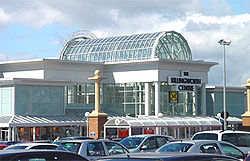
Killingworth History of commerce in Killingworth
This is a large white building in the town centre. Originally, a building owned by Merz & McLellan, built in the 1960s, stood here. This office block contained 100,000 square feet (10,000 m²) of office space and employed 600 professional and clerical people. Constructed by Northumberland County Council, the building towered over Killingworth and could be seen for miles around. Over the years, the office space became vacant and, like the former Woolco site, it was disused through the 1990s. Then the building was reduced in height, remodernised, reopened and renamed the White Swan Centre. It incorporates the Killingworth Library, North Tyneside Council Rent and Rates Office, Education Centre, Coffee Shop, Fitness Centre, and Conference Rooms.

Killingworth Schools
Killingworth has two public houses (and there are two more in Killingworth Village).

The West House, originally called the West House Inn, is in West Bailey. It was built from a derelict farmhouse and barn, in the style of an old Northumberland inn.
The Station public house is on the industrial estate to the west of the town. It was originally next to the Killingworth railway station, which was demolished some years ago. The railway still runs by the Station pub, with a level crossing within 50m of the pub.
Killingworth Working Men's Social Club (in East Bailey) was built in the 1970s and located next to the Town Centre.

Wednesday, January 2, 2008

Sonic Theater
Sonic Theater is a channel on the XM Satellite Radio network that specializes in playing Audio Books and Radio Dramas. It is available on channel 163 on XM. The program director is Josephine Reed. Effective 2007-08-03, Sonic Theater only broadcasts on weekdays (Monday at midnight ET through Friday at 11:59PM ET).

Tuesday, January 1, 2008

John Jamieson
Reverend John Jamieson, D.D. (March 3, 1759 – July 12, 1838) was a Scottish lexicographer, son of a minister, born in Glasgow.
He was educated at the University of Glasgow, and subsequently attended classes at the University of Edinburgh After six years' theological study, Jamieson was licensed to preach in 1789 and became pastor of an Anti-burgher congregation in Forfar, Angus; and in 1797 he was called to the Anti-burgher church in Nicolson Street, Edinburgh. The union of the Burgher and Anti-burgher sections of the Secession Church in 1820 was largely due to his exertions. He retired from the ministry in 1830, spending the rest of his life in Edinburgh.
Dr Jamieson had a strong literary bias and keen interest in antiquarian research. His name stands at the head of a tolerably long list of works in the Bibliotheca britannica; but by far his most important book is the laborious and erudite compilation, best described by its own title-page:
An Etymological Dictionary of the Scottish Language [i.e. Lowland Scots, not Scottish Gaelic]; illustrating the words in their different significations by example from Ancient and Modern Writers; shewing their Affinity to those of other Languages, and especially the Northern; explaining many terms which though now obsolete in England were formerly common to both countries; and elucidating National Rites, Customs and Institutions and their Analogy to those of other nations; to which is prefixed a Dissertation on the Origin of the Scottish Language.
This appeared in 2 vols quarto, at Edinburgh in 1808, followed in 1825 by a Supplement, in 2 vols., quarto, in which he was assisted by scholars in all parts of the country. A revised edition by Longmuir and Donaldson was issued in 1879-1887. These volumes remained the reference work of choice regarding the Scots language until the publication of the Scottish National Dictionary in 1931.
Jamieson was a Fellow of the Royal Society of Edinburgh, of the American Antiquarian Society and of the Society of Antiquaries of Scotland. In 1789, he published Sermons of the Heart, and around the same time authored a pamphlet on the African slave trade entitled, The Sorrows of Slavery.
In 1781, Dr Jamieson married Charlotte, daughter of Robert Watson, Esq., of Easter Rhind, Perthshire, and had seventeen children, of whom only two daughters and one son survived. His son, Robert Jameson, Esq., advocate, became a distinguished member of the Faculty of Advocates.