Friday, February 22, 2008

Livability Court
A Livability Court is a municipal court (or court of limited jurisdiction) focused on cases involving non-compliance with codes and standards about housing, waste, the environment, noise, animal control, zoning, traffic, and tourism. The first Livability Court in the United States was created in Charleston, South Carolina, in 2002..

Thursday, February 21, 2008


Namibia, officially the Republic of Namibia, is a country in southern Africa on the Atlantic coast. It shares borders with Angola, and Zambia to the north, Botswana to the east, and South Africa to the south. It gained independence from South Africa in 1990 and its capital city is Windhoek (German: Windhuk). Namibia is a member state of the United Nations (UN), the Southern African Development Community (SADC), the African Union (AU), and the Commonwealth of Nations.

History

Main articles: Regions of Namibia and Constituencies of Namibia Regions and constituencies

Main articles: Geography of Namibia and Towns in Namibia Economy
Namibia generally attracts eco-tourists with the majority visiting to experience the different climates and natural geographical landscapes such as the great eastern desert and plains. There are many lodges and reserves for eco-tourists to travel to and stay over.

Tourism

Main article: Politics of Namibia Politics

Main article: Communal Wildlife Conservancies in Namibia Communal Wildlife Conservancies

Main article: Demographics of Namibia Demographics
The HIV/AIDS epidemic is a very large problem in Namibia. Namibia's infection rate is one of the highest on the continent and it shares its eastern border with Botswana which has the highest rate of almost 39%. In 2001, there were an estimated 210,000 people living with HIV/AIDS, and the estimated death toll in 2003 was 16,000 . Given infection rates this large as well as a looming malaria problem, it may be very difficult for the government to deal with both the medical and economic impacts of this epidemic.

HIV/AIDS in Namibia

Main article: Foreign relations of Namibia Foreign relations
Namibia is involved in several minor international disputes, including:

Small residual disputes with Botswana along the Caprivi Strip, including the Situngu marshlands (known as Kasikili Island in Namibia side along the Linyanti River, for which a commission to seek a resolution has been established;
Protests from Botswana residents against Namibia's planned construction of the Okavango hydroelectric dam at the Popa Falls;
A managed dispute with South Africa over the location of the boundary along the Orange River;
A dormant dispute over where the boundaries of Botswana, Namibia, Zambia and Zimbabwe converge;
Disputes over Angolan rebels and refugees residing in Namibia. International disputes

Main article: Military of NamibiaNamibia Military

Frankie Fredericks
Adolph Jentsch
List of Namibians See also

List of cities in Namibia
List of Namibia-related topics
National parks

Wednesday, February 20, 2008


Meta-ethics Normative · Descriptive Consequentialism Deontology Virtue ethics Ethics of care Good and evil · Morality
Bioethics · Medical Engineering · Environmental Human rights · Animal rights Legal · Media Business · Marketing Religion · War Justice · Value Right · Duty · Virtue Equality · Freedom · Trust Free will · Consent · Moral responsibility
Aristotle · Confucius · Aquinas Hume · Kant Bentham · MillEthics in religion Kierkegaard · Nietzsche Hare · Rawls · MacIntyre Singer · Gilligan
List of ethics topics List of ethicists
Ethics is a branch of philosophy dealing with right and wrong in human behavior. Most religions have a moral component, and religious approaches to the problem of ethics historically dominated ethics over secular approaches. From the point of view of theistic religions, to the extent that ethics stems from revealed truth from divine sources, ethics is studied as a branch of theology. Many believe that the Golden Rule, which teaches people to "treat others as you want to be treated", is a common denominator in many major moral codes and religions.

Ethics in the Bible

Main article: Jewish ethics Jewish ethics
Ethics in systematic form, and apart from religious belief, is as little found in apocryphal or Judæo-Hellenistic literature as in the Bible. However, Greek philosophy greatly influenced Alexandrian writers such as the authors of IV Maccabees, the Book of Wisdom, and Philo.
Much progress in theoretical ethics came as Jews came into closer contact with the Hellenic world. Before that period the Wisdom literature shows a tendency to dwell solely on the moral obligations and problems of life as appealing to man as an individual, leaving out of consideration the ceremonial and other laws which concern only the Jewish nation. From this point of view Ben Sira's collection of sayings and monitions was written, translated into Greek, and circulated as a practical guide. The book contains popular ethics in proverbial form as the result of everyday life experience, without higher philosophical or religious principles and ideals. More developed ethical works emanated from Hasidean circles in the Maccabean time, such as are contained in Tobit, especially in ch. iv.; here the first ethical will or testament is found, giving a summary of moral teachings, with the Golden Rule, "Do that to no man which thou hatest!" as the leading maxim. There are even more elaborate ethical teachings in the Testaments of the Twelve Patriarchs, in which each of the twelve sons of Jacob, in his last words to his children and children's children, reviews his life and gives them moral lessons, either warning them against a certain vice he had been guilty of, so that they may avoid divine punishment, or recommending them to cultivate a certain virtue he had practised during life, so that they may win God's favor. The chief virtues recommended are: love for one's fellow man; industry, especially in agricultural pursuits; simplicity; sobriety; benevolence toward the poor; compassion even for the brute (Issachar, 5; Reuben, 1; Zebulun, 5-8; Dan, 5; Gad, 6; Benjamin, 3), and avoidance of all passion, pride, and hatred. Similar ethical farewell monitions are attributed to Enoch in the Ethiopic Enoch (xciv. et seq.) and the Slavonic Enoch (lviii. et seq.), and to the three patriarchs.
The Hellenistic propaganda literature made the propagation of Jewish ethics taken from the Bible its main object for the sake of winning the pagan world to pure monotheism. It was owing to this endeavor that certain ethical principles were laid down as guiding maxims for the Gentiles; first of all the three capital sins, idolatry, murder, and incest, were prohibited (see Sibyllines, iii. 38, 761; iv. 30 et seq.). In later Jewish rabbinic literature these "Noachide Laws" were gradually developed into six, seven, and ten, or thirty laws of ethics binding upon every human being.

Ethics in the Jewish Apocrypha
The Mussar Movement is a Jewish ethical movement which developed in the 19th century, and which still exists today.

Modern Jewish Ethics
Christian ethics developed while early Christians were subjects of the Roman Empire. From the time Nero blamed Christians for setting Rome ablaze (64 AD) until Galarius (311 AD), persecutions against Christians erupted periodically. Consequently, early Christian ethics included discussions of how believers should relate to Roman authority and to the empire.
Under the Emperor Constantine I (312-337), Christianity became the religion of the state. While some scholars debate whether Constantine's conversion to Christianity was authentic or simply matter of political expediency, Constantine's decree made the empire safe for Christian practice and belief. Consequently, issues of Christian doctrine, ethics and church practice were debated openly. By the time of Theodosius I (379-395), Christianity had become the normative religion of the empire. With Christianity now in power, ethical concerns broaden and included discussions of the proper role of the state.
Saint Augustine adapted Plato, and later, after the Islamic transmission of his works, Aquinas worked Aristotelian philosophy into a Christian framework.
Christian ethics in general has tended to stress the need for grace, mercy, and forgiveness because of human weakness. With divine assistance, the Christian is called to become increasingly virtuous in both thought and deed. Conversely, the Christian is also called to abstain from vice. There are several different schema of vice and virtue. Aquinas adopted the four cardinal virtues of Plato, (justice, courage, temperance, prudence) and added to them the Christian virtues of faith, hope and love (from St.Paul, First Corinthians 13). Other schema include the Seven Deadly Sins and the Seven virtues. For more see Christian philosophy.

Christian ethics
Paul teaches (Rom., ii, 24 ff) that God has written his moral law in the hearts of all men, even of those outside the influence of Christian revelation; this law manifests itself in the conscience of every man and is the norm according to which the whole human race will be judged on the day of reckoning. In consequence of their perverse inclinations, this law had become, to a great extent, obscured and distorted among the pagans; Christian understand their mission as, to restore it to its pristine integrity.
The New Testament generally asserts that all morality flows from the Great Commandment to love God with all one's heart, mind, strength, and soul, and to love one's neighbor as oneself. In reaffirming this Great Commandment, Jesus Christ was reaffirming the teaching of the Torah.
Ecclesiastical writers, as Justin Martyr, Irenaeus, Tertullian, Clement of Alexandria, Origen, Ambrose, Jerome, and Augustine of Hippo all wrote on ethics from a distinctly Christian point of view. Interestingly, they made use of philosophical and ethical principles laid down by their Greek (Pagan) philosopher forbears.
The Church fathers had little occasion to treat moral questions from a purely philosophical standpoint and independently of Christian Revelation; but in the explanation of Catholic doctrine their discussions naturally led to philosophical investigations.
This is particularly true of Augustine, who proceeded to develop thoroughly along philosophical lines and to establish firmly most of the truths of Christian morality. The eternal law (lex aeterna), the original type and source of all temporal laws, the natural law, conscience, the ultimate end of man, the cardinal virtues, sin, marriage, etc. were treated by him in the clearest and most penetrating manner. Hardly a single portion of ethics does he present to us but is enriched with his keen philosophical commentaries. Late ecclesiastical writers followed in his footsteps.

Scholasticism
Far different from Catholic ethical methods were those adopted for the most part by Protestants. With the rejection of the Church's teaching authority, each individual became on principle his own supreme teacher and arbiter in matters appertaining to faith and morals. The Reformers held fast to the Bible as the infallible source of revelation, but as to what belongs or does not belong to it, whether, and how far, it is inspired, and what is its meaning — all this was left to the final decision of the individual.
Philipp Melanchthon, in his "Elementa philosophiae moralis", still clung to the Aristotelean philosophy; so, too, did Hugo Grotius, in his work, "De jure belli et pacis". But Cumberland and his follower, Samuel Pufendorf, moreover, assumed, with Descartes, that the ultimate ground for every distinction between good and evil lay in the free determination of God's will, a view which renders the philosophical treatment of ethics fundamentally impossible.
In the 20th century, some Christian philosophers, notably Dietrich Bonhoeffer questioned the value of ethical reasoning in moral philosophy. In this school of thought, ethics, with its focus on distinguishing right from wrong, tends to produce behavior that is simply not wrong, whereas the Christian life should instead be marked by the highest form of right. Rather than ethical reasoning, they stress the importance of meditation on and relationship with God.

Protestant Ethics
Hindu ethics are related to reincarnation, which is a way of expressing the need for reciprocity, as one may end up in someone else's shoes in their next incarnation. Intention is seen as very important, and thus selfless action for the benefit of others without thought for oneself is an important rule in Hinduism, known as the doctrine of karma yoga. This aspect of service is combined with an understanding that someone else's unfortunate situation, while of their own doing, is one's own situation since the soul within is the soul shared by all. The greeting namaskar is founded on the principle that one salutes the spark of the divine in the other. Kindness and hospitality are key Hindu values.
More emphasis is placed on empathy than in other traditions, and women are sometimes upheld not only as great moral examples but also as great gurus. Beyond that, the Mother is a Divine Figure, the Devi, and the aspect of the creative female energy plays a major role in the Hindu ethos. Vande Mataram, the Indian national song (not anthem) is based on the Divine mother as embodied by 'Mother India' paralleled to 'Ma Durga'. An emphasis on domestic life and the joys of the household and village may make Hindu ethics a bit more conservative than others on matters of sex and family.
Of all religions, Hinduism is among the most compatible with the view of approaching truth through various forms of art: its temples are often garishly decorated, and the idea of a guru who is both entrancing entertainer and spiritual guide, or who simply practices some unique devotion (such as holding up his arm right for his whole life, or rolling on the ground for years on a pilgrimage), is simply accepted as a legitimate choice in life.
Ethical traditions in Hinduism have been influenced by caste norms. In the mid-20th century Mohandas Gandhi, a Vaishnava, undertook to reform these and emphasize traditions shared in all the Indian faiths:
After his profound achievement of forcing the British Empire from India, these views spread widely and influence much modern thinking on ethics today, especially in the peace movement, ecology movement, and those devoted to social activism.
Many New Age traditions also derive from his thought and other Hindu traditions such as acceptance of reincarnation, which is a way of expressing the need for reciprocity, as one may end up in someone else's shoes "in a future life". A cardinal virtue in Hinduism is kindness.

vegetarianism and an ideology of harms reduction leading ultimately to nonviolence
active creation of truth through courage and his 'satyagraha'
rejection of cowardice and concern with pain or indeed bodily harm Hindu ethics
Bhikkhu Bodhi wrote: The need to internalize ethical virtue as the foundation for the Buddhist path translates itself into a set of precepts established as guidelines to good conduct. The most basic set of precepts found in the Buddha's teaching is the pañcasila, the five precepts, consisting of the following five training rules:
(1) the training rule of abstaining from taking life; (2) the training rule of abstaining from taking what is not given; (3) the training rule of abstaining from sexual misconduct; (4) the training rule of abstaining from false speech; and (5) the training rule of abstaining from fermented and distilled intoxicants which are the basics for heedlessness.
These five precepts are the minimal ethical code binding on the Buddhist laity. They are administered regularly by the monks to the lay disciples at almost every service and ceremony. They are also undertaken afresh each day by earnest lay Buddhists as part of their daily recitation.
It has to be pointed out that the five precepts, or even the longer codes of precepts promulgated by the Buddha, do not exhaust the full range of Buddhist ethics. The precepts are only the most rudimentary code of moral training, but the Buddha also proposes other ethical codes inculcating definite positive virtues. The Mangala Sutta, for example, commends reverence, humility, contentment, gratitude, patience, generosity, etc. Other discourses prescribe numerous family, social, and political duties establishing the well being of society. And behind all these duties lie the four attitudes called the "immeasurables" or brahma-viharas — loving-kindness (metta), compassion, sympathetic joy (mudita), and equanimity.
Corresponding to the negative side of abstaining from the destruction of life, there is the positive side of developing compassion and sympathy for all beings. Similarly, abstinence from stealing is paired with honesty and contentment, abstinence from sexual misconduct is paired with marital fidelity in the case of lay people and celibacy in the case of monks, abstinence from falsehood is paired with speaking the truth, and abstinence from intoxicants is paired with heedfulness.
In order to develop the positive virtues we have to begin by abstaining from the negative qualities opposed to them. The growth of the positive virtues will only be stunted or deformed as long as the defilements are allowed to reign unchecked. We cannot cultivate compassion while at the same time indulging in killing, or cultivate honesty while stealing and cheating. At the start we have to abandon the unwholesome through the aspect of avoidance. Only when we have secured a foundation in avoiding the unwholesome can we expect to succeed in cultivating the factors of positive performance. Source

Buddhist ethics
Chinese traditional systems of thought are both varied and often syncretic, so it is difficult to point to a single, central structure to Chinese ethics. In addition, there is always the question of whether beliefs form behaviour, or behavior forms beliefs — in other words, whether an ethical system is something that people try to follow, or just a description of what they do. However, this being said, it is nonetheless true that there are several basic threads in Chinese traditional ethics.
Confucianism and Neo-Confucianism emphasize the maintenance and propriety of relationships as the most important consideration in ethics. To be ethical is to do what one's relationships require. Notably, though, what you owe to another person is inversely proportional to their distance from you. In other words, you owe your parents everything, but you are not in any way obligated towards strangers. This can be seen as a recognition of the fact that it is impossible to love the entire world equally and simultaneously. This is called relational ethics, or situational ethics. The Confucian system differs very strongly from Kantian ethics in that there are rarely laws or principles which can be said to be true absolutely or universally.
This is not to say that there has never been any consideration given to universalist ethics. In fact, in Zhou dynasty China, the Confucians' main opponents, the followers of Mozi argued for universal love, jian'ai. The Confucian view eventually held sway, however, and continues to dominate many aspects of Chinese thought. Many have argued, for example, that Mao Zedong was more Confucian than Communist. Confucianism, especially of the type argued for by Mencius (Mengzi), argued that the ideal ruler is the one who (as Confucius put it) "acts like the North Star, staying in place while the other stars orbit around it". In other words, the ideal ruler does not go out and force the people to become good, but instead leads by example. The ideal ruler fosters harmony rather than laws.
Confucius stresses honesty above all. His concepts of li 理, yi 義, and ren 仁 can be seen as deeper expressions of honesty (cheng 誠, commonly translated as "sincerity") and fidelity (xiao 孝) to the ones to whom one owes one's existence (parents) and survival (one's neighbours, colleagues, inferiors in rank). He codifed traditional practice and actually changed the meaning of the prior concepts that those words had meant. His model of the Confucian family and Confucian ruler dominated Chinese life into the early 20th century. This had ossified by then into an Imperial hierarchy of rigid property rights, hard to distinguish from any other dictatorship. Traditional ethics had been perverted by legalism.
There are many other major threads in Chinese ethics. Buddhism, and specifically Mahayana Buddhism, brought a cohesive metaphysic to Chinese thought and a strong emphasis on universalism. Neo-Confucianism was largely a reaction to Buddhism's dominance in the Tang dynasty, and an attempt at developing a native Confucian metaphysical/analytical system.
Laozi and other Daoist authors argued for an even greater passivity on the part of rulers than did the Confucians. For Laozi, the ideal ruler is one who does virtually nothing that can be directly identified as ruling. Clearly, both Daoism and Confucianism presume that human nature is basically good. The main branch of Confucianism, however, argues that human nature must be nurtured through ritual (li 理), culture (wen 文) and other things, while the Daoists argued that the trappings of society were to be gotten rid of.
The Legalists, such as Hanfeizi, argued that people are not innately good. Laws and punishments are therefore necessary to keep the people good. Actual governing in China has almost always been a mixture of Confucianism and Legalism.
When the last dynasty of China, the Qing (1644-1911) fell, Chinese Nationalist reformer and Christian convert Sun Yat-Sen introduced modern notions of ethics and democracy. He remains the only twentieth century figure respected by Nationalist, Communist and modernizers alike.
Mao Zedong combined Classical Legalism and other native political infuences with the Marxist-Leninist emphasis on the role of economics in determining ethical relations. His Quotations of Chairman Mao were mandatory reading, and perhaps a billion copies are in existence. He emphasized the relation between power and the "mass line" of choices made by ordinary people in real life. Maoism is not very popular today, but his absolute rule of China made it impossible to avoid this strict bottom-up, agrarian, concept of ethics. In practice, of course, power flowed from the top. Ethical discourses are still viewed with suspicion in most of China today, as the behaviour of power seems rarely to be actually motivated by ethical norms.
Still, honesty and fidelity remain central to Chinese ethical thought. Where Mao is remembered unsympathetically in China, it is less for his brutality than for not doing as he said.

Chinese traditional ethics

Main article: Islamic ethics Islamic ethics
See Shinto.

Animist ethics

The Golden Rule
Ethics in the Bible
Catholic moral theology
Neetham
Divine command ethics
Seven virtues
Secular Morality
Studies in Christian Ethics

Tuesday, February 19, 2008


Castine is a town in Hancock County, Maine, United States. As of the 2000 census, the town had a total year-round population of 1,343.

Castine, Maine Info
As of the census of 2000, there were 1,343 people, 372 households, and 222 families residing in the town. The population density was 66.5/km² (172.2/mi²). There were 649 housing units at an average density of 32.1/km² (83.2/mi²). The racial makeup of the town was 97.10% White, 0.67% African American, 0.60% Native American, 0.74% Asian, 0.22% from other races, and 0.67% from two or more races. Hispanic or Latino of any race were 0.60% of the population.
There were 372 households out of which 18.0% had children under the age of 18 living with them, 49.2% were married couples living together, 7.0% had a female householder with no husband present, and 40.3% were non-families. 30.1% of all households were made up of individuals and 12.4% had someone living alone who was 65 years of age or older. The average household size was 2.16 and the average family size was 2.69.
In the town the population was spread out with 10.3% under the age of 18, 41.9% from 18 to 24, 15.0% from 25 to 44, 18.4% from 45 to 64, and 14.4% who were 65 years of age or older. The median age was 24 years. For every 100 females there were 186.4 males. For every 100 females age 18 and over, there were 196.8 males.
The median income for a household in the town was $46,250, and the median income for a family was $65,500. Males had a median income of $36,250 versus $30,893 for females. The per capita income for the town was $20,078. About 3.2% of families and 12.0% of the population were below the poverty line, including 10.9% of those under age 18 and 4.7% of those age 65 or over.

Demographics

History
Castine is one of the oldest towns in New England, predating the Plymouth Colony by seven years. Few places in New England can boast a more tumultuous or varied history than Castine -- which proclaims itself the "battle line of four nations."
Its commanding position at the mouth of the Penobscot River, a rich source of furs and timber and a major transportation route into the interior, made the peninsula now occupied by the town of Castine of particular interest to European powers in the seventeenth century. The area changed hands numerous times with the shifting tides of imperial politics. At one time or another, it was occupied by the French, Dutch, and England's Plymouth Colony.
The Castine peninsula appears on a 1612 chart submitted to King Henry IV of France by Samuel de Champlain, who called it the Pentagoët (sometimes spelled Pentagöet) Peninsula. As part of Henry's program to defend Acadia, Castine was founded in the winter of 1613, when Sieur Claude de Turgis de la Tour established a small trading post to among the Tarrantine Indians. John Smith charted it in 1614. At some point, some sort of crude defences were erected, and it was called "Fort Penagoët". Castine soon became a force in colonial trade and diplomacy.
Pentagoët was attacked and briefly held by the Dutch in 1674 and 1676, turning the fort's cannon on its own walls and destroying most of it after the second siege. Castin himself retook it in 1676 and renamed the town "Bagaduce".In 1692, the village was again seized by the English, who destroyed the fort and looted the settlement. With the return of Castine and his sons to France, the settlement became sparsely occupied, and peaceful, until the eve of the American Revolution.
At the end of the French and Indian War, which secured English title to North America, the unoccupied lands along the Maine coast were opened to settlement by Massachusetts colonists. By the late 1760s, farmers, artisans, and small traders were beginning to take title to properties in and around "Major Baggadoose." Though the fur trade was long dead, the region's abundant fisheries and timber attracted not only entrepreneurs, but also the attention of the British government, which was always on the lookout for store to supply its growing navy. Bagaduce was especially valuable for timber, which was suitable for masts on British warships.
In early July of 1779, nearly three years after the Americans had declared independence from Britain, a naval and military force under the command of General Francis McLean, sailed into the settlement's commodious harbor, landed troops, and took control of the village. They began erecting Fort George on one of the highest points of the peninsula. Alarmed by this incursion, the Massachusetts legislature dispatched an expedition -- consisting of a fleet of 19 armed vessels and 24 transports, carrying 344 guns, under Dudley Saltonstall, and a land force of about 1,200 men, under Gen. Samuel Lovell, seconded by Gen. Peleg Wadsworth; Col. Paul Revere having charge of the ordnance.
Though badly outnumbered, the British soldiers of the 74th Regiment of Foot (Argyle Highlanders), managed to repel American attacks for nearly three weeks. In mid-August, British reinforcements appeared at the head of the bay. The Americans eventually abandoned the fight and retreated up the Penobscot River, destroying their entire fleet along the way to keep it out of British hands. The failed Penobscot Expedition, which cost the revolutionaries eight million dollars, proved to be the greatest American naval defeat until Pearl Harbor (December 1941). The 74th Regiment held Majabagaduce until the end of the war, when it was ceded to the Americans as part of the peace settlement. Saltonstall and Revere were later court-martialed, charged with cowardice and insubordination; Saltonsall was found guilty, but Revere was acquitted.
At the end of the Revolutionary War, many loyal British subjects in the area, subsequently known as United Empire Loyalists, migrated eastward; many of them towing their houses behind their boats. These Penobscot Loyalists crossed the newly established international boundary line of the St. Croix River and established St. Andrews, one of the oldest towns in New Brunswick. In addition, many soldiers of the 74th chose to be disbanded in St. Andrews (last muster 24 May 1784), and took up land grants there along with the Loyalists, rather than return home to Britain.

Early History
With the growth of the postwar economy, the town became a prosperous place: the seat of Hancock County and a center for shipbuilding and coastal trading. The town was occupied by the British for eight months during the War of 1812. By the 1820s, it had become a major entrepot for American fishing fleets on their way to the Grand Banks. The town also prospered from the lumber industry, for which eastern Maine as become the national center in the years before the Civil War. During this period of growth and prosperity, many of the handsome mansions that still grace the village's streets were constructed.
Castine declined after the Civil War. Its fleet, which once sailed the globe, now carried coal, firewood, and lime to coastal ports, competing with railroads and steamships. Ambitious young people sought their fortunes elsewhere. The Hancock County seat moved to Ellsworth in 1838.
By the 1870s, its quaint old houses were becoming attractive to "rusticators" -- well-to-do urban families in search of summer rest and recreation. The town attracted a number of notables, among them Harriet Beecher Stowe and Henry Wadsworth Longfellow, whose writings helped to romanticize its past. By the 1890s, wealthy families from Boston, Hartford, and Chicago, were buying up old farms and sea captains' houses and establishing a flourishing summer colony. Castine also became the location of the Eastern State Normal School.
Castine reached its economic nadir in the 1930s. The Depression and the automobile had killed off the hotel trade, the steamship lines that had linked coastal towns and islands, and the local fishing industry. Its fortunes did not revive until the 1960s, with the rediscovery of the town's charms by a new generation of summer people -- including such notables as poet Robert Lowell, critic Elizabeth Hardwick, novelist Mary McCarthy, singer-songwriter Don McLean, and Nobel Prize winning biochemist Carl Ferdinand Cori.

1800-Present
A key element in the town's revival has been the expansion of the Maine Maritime Academy [2].
Established in 1941 to train merchant seamen, by the 1980s the Academy offered a range of courses in engineering, management, transportation, and nautical and ocean science. Its handsome campus, once the home of the Eastern State Normal School, boasts an excellent library (which is open to the general public) and extensive athletic facilities.
By the 1980s, many of the old hotels had reopened, boasting first-rate dining facilities. The harbor, almost entirely empty in the 1950s, filled with luxury yachts. Prosperity was given an added boost by the willingness of financially comfortable retirees to brave Maine winters in their golden years. (Though some cynics now call the town "New Canaan-by-the-Sea").
Nonetheless, Castine has pleasant tourist amenities: several historical parks (such as the ruins of the British earthworks at Fort George), an excellent deep water harbor (with tie-ups for small boats outside the current of the Penobscot and Bagaduce rivers), a non-exclusive club offering golf, tennis, and yachting facilities [3], good restaurants, and four churches (Episcopal, Roman Catholic, Trinitarian Congregational, and Unitarian Universalist). In addition, the town boasts a fine public library, an active historical society [4], and a unique museum [5] featuring exhibits of anthropological, natural, and local artifacts. Castine's streets are still lined with large elms which are being replaced with disease-resistant strains as they die. The area has numerous marked historical sites and streets of lovely Cape and Federal style houses. The Castine Post Office is the oldest post office (in continuous operation) in the United States.

Notes
Buker, George E. 2002. "The Penobscot Expedition: Commodore Saltonstall and the Massachusetts Conspiracy of 1779." Annapolis, MD: Naval Institute Press.
Bourne, Russell. 1989. "The View from Front Street: Travels through New England's Historic Fishing Communities." New York : W.W. Norton.
Bourne, Russell. 1990. 'The Red King's Rebellion: Racial politics in New England, 1675-1678." New York, NY: Atheneum, 1990.
Doudiet, Ellenore. 1978. "Majabigwaduce: Castine, Penobscot, and Brooksville." Castine, ME: Castine Scientific Society.
Faulkner, Alaric, 1987. "The French at Pentagoet, 1635-1674: An Archaeological Portrait of the Acadian Frontier." Augusta, ME: Maine Historic Preservation Commission.
Maine League of Historical Societies and Museums (1970). in Doris A. Isaacson: Maine: A Guide 'Down East'. Rockland, Me: Courier-Gazette, Inc., 349-351. 
Wasson, George Savary. 1932. Sailing Days on the Penobscot: The River and Bay as They Were in the Old Days; with a Record of Vessels Built There, Compiled by Lincoln Colcord. Salem, MA: Marine Research society, 1932.
Wheeler, George A. 1923. "History of Castine: Battle Line of Four Nations." Cornwell, NY: privately printed.

Monday, February 18, 2008

Italian partisans
The Italian resistance movement was a partisan force during World War II.

Origins of the movement
In 1944, with the Allied forces nearby, the partisan resistance in Italy staged an uprising behind German lines, led by the Committee of National Liberation of Upper Italy (CLNAI). This rebellion led to the establishment of a number of provisional partisan governments throughout the mountainous regions of northern Italy, of which Ossola was the most important and received recognition from Switzerland and from Allied consulates in Switzerland. By the end of 1944, German reinforcements and Benito Mussolini's remaining forces had crushed the uprising, and the area's liberation had to wait until the final offensives of 1945.

New territorial structures

Alto Monferrato (Sep-2 Dec)
Alto Tortonese (Sep-Dec)
Bobbio (7 Jul - 27 Aug)
Cansiglio (Jul-Sep)
Carnia (Jul-Oct)
Friuli Orientale (30 Jun - Sep)
Imperia (Aug-Oct)
Langhe (Sep-Nov)
Montefiorino (17 Jun - 1 Aug)
Ossola (10 Sep - 23 Oct)
Val Ceno (10 Jun - 11 Jul)
Val d'Enza e Val Parma (Jun-Jul)
Val Maira e Val Varaita (Jun - 21 Aug)
Val Taro (15 Jun - 24 Jul)
Valli di Lanzo (25 Jun - Sep)
Valsesia (11 Jun - 10 Jul)
Varzi (19/24 Sep - 29 Nov) April 25
The April uprising showed to the world that not all Italians agreed with the Fascist rule. Furthermore, it proved that Italians were even prepared to fight against Fascist rule at great cost to themselves. Casualties from the uprising amounted to:
During the war, German and Italian Fascist soldiers committed a number of other war crimes including:
Most of these were common practices.
Some of the most notorious events were the Ardeatine massacre, the Marzabotto massacre, and the Sant'Anna di Stazzema massacre. Captured partisans or civilians were often tortured. The Decima Flottiglia MAS, an Italian unit under German command, is now remembered as one of the most ruthless military corps of the war.
The Germans profited greatly from the weakness of the Fascist puppet state in Northern Italy. The Germans determined that they would "annex" Italian territories into the Third Reich. Two new German regions were to be established. One was the Alpenvorland and it was to comprise the region of Trentino-Alto Adige/Südtirol and the Province of Belluno. The other was Adriatisches Kustenland and it was to comprise Istria, Quarnero, and most of today's region of Friuli-Venezia Giulia. In the valley of Carnia, anti-Communist forces from the Soviet Union under the command of ataman Timofey Ivanovich Domanov were used; they were promised the establishment of a Cossack republic in Northeastern Italy, to be called Kosakenland.[2]

Approximately 44,700 Italian partisans killed
Approximately 21,200 Italian partisans wounded or disabled
Approximately 15,000 Italian civilians killed in retaliations
Approximately 40,000 former Italian soldiers died in concentration camps
Summary Executions
Ransacking
Retaliations against civilians Capture and execution of Mussolini

Arditi del Popolo

Wednesday, February 13, 2008

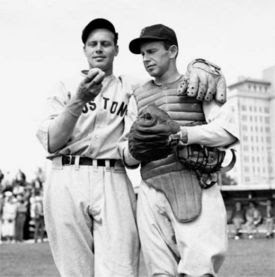
Career

Wes Ferrell Batting statistics

The 100 Greatest Cleveland Indians Roster
List of Major League Baseball wins champions
MLB all-time leaders in home runs by pitchers
List of Major League Baseball no-hitters

Tuesday, February 12, 2008


In computing, a mouse (plural mice or mouses) functions as a pointing device by detecting two-dimensional motion relative to its supporting surface. Physically, a mouse consists of a small case, held under one of the user's hands, with one or more buttons. It sometimes features other elements, such as "wheels", which allow the user to perform various system-dependent operations, or extra buttons or features can add more control or dimensional input. The mouse's motion typically translates into the motion of a pointer on a display.
The name mouse, coined at the Stanford Research Institute, derives from the resemblance of early models (which had a cord attached to the rear part of the device, suggesting the idea of a tail) to the common eponymous rodent.
The first marketed integrated mouse — shipped as a part of a computer and intended for personal computer navigation — came with the Xerox 8010 Star Information System in 1981.

Technologies
Douglas Engelbart of the Stanford Research Institute invented the mouse in 1963


Early mice
Bill English, builder of Engelbart's original mouse,

Mechanical mice
An optical mouse uses a light-emitting diode and photodiodes to detect movement relative to the underlying surface, rather than moving some of its parts — as in a mechanical mouse.
Early optical mice, circa 1980, came in two different varieties:
These two mouse types had very different behaviors, as the Kirsch mouse used an x-y coordinate system embedded in the pad, and would not work correctly when rotated, while the Lyon mouse used the x-y coordinate system of the mouse body, as mechanical mice do.
As computing power grew cheaper, it became possible to embed more powerful special-purpose image-processing chips in the mouse itself. This advance enabled the mouse to detect relative motion on a wide variety of surfaces, translating the movement of the mouse into the movement of the pointer and eliminating the need for a special mouse-pad. This advance paved the way for widespread adoption of optical mice.
Modern surface-independent optical mice work by using an optoelectronic sensor to take successive pictures of the surface on which the mouse operates. Most of these mice use LEDs to illuminate the surface that they track over; marketers often mislabel these LED optical mice as laser mice, confusing them with true laser mice. Changes between one frame and the next are processed by the image processing part of the chip and translated into movement on the two axes using an optical flow estimation algorithm. For example, the Avago Technologies ADNS-2610 optical mouse sensor processes 1512 frames per second: each frame consisting of a rectangular array of 18×18 pixels, and each pixel can sense 64 different levels of gray. Laser mice
Optical mice have no rolling parts, and therefore (unlike mechanical mice, which can clog up with lint) they do not normally require maintenance other than removing debris that might collect under the light-emitter. However, they generally cannot track on glossy and transparent surfaces, including some mouse-pads, sometimes causing the cursor to drift unpredictably during operation. Mice with less image-processing power also have problems tracking fast movement, though high-end mice can track at 2 m/s (80 inches per second) and faster.
Proponents note that some models of laser mice can track on glossy and transparent surfaces, and have a much higher sensitivity than either their mechanical or optical counterparts. Such models of laser mice cost more than both their LED based counterparts and mechanical mice.
As of 2006, mechanical mice have lower average power demands than their optical counterparts. This typically has no practical impact for users of cabled mice (except possibly those used with battery-powered computers, such as notebook models), but has an impact on battery-powered wireless models.
Optical models will outperform mechanical mice on uneven, slick, squishy, sticky or loose surfaces, and generally in mobile situations lacking mouse pads. Since optical mice render movement based on an image which the LED illuminates, use with multi-colored mousepads may result in unreliable performance, however, laser mice do not suffer these problems and will track on such surfaces. The advent of affordable high-speed, low-resolution cameras and the integrated logic in optical mice provides an ideal laboratory for experimentation on next-generation input-devices. Experimenters can obtain low-cost components simply by taking apart a working mouse and changing the optics or by writing new software.

Optical versus mechanical mice
Inertial mice use a tuning fork or other accelerometer (US Patent 4787051) to detect movement for every axis supported. Usually cordless, they often have a switch to deactivate the movement circuitry between use, allowing the user freedom of movement without affecting the pointer position. A patent for an inertial mouse claims that such mice consume less power than optically based mice, offer an increased level of sensitivity, and reduced weight and increased ease-of-use.

Inertial mice
Also known as flying mice, bats, or wands, these devices generally function through ultrasound. Probably the best known example would be 3DConnexion/Logitech's SpaceMouse from the early 1990s.
In the late 1990s Kantek introduced the 3D RingMouse. This wireless mouse was worn on a ring around a finger, which enabled the thumb to access three buttons. The mouse was tracked in three dimensions by a base station. Despite a certain appeal, it was finally discontinued because it did not provide sufficient resolution.
A recent consumer 3D pointing device is the Wii Remote. While primarily a motion-sensing device (that is, it can tell which way it's going and which way it's tilted), Wii Remote can also detect its spatial position by comparing the distance and position of the lights from the IR emitter using its integrated IR camera (since the nunchuk lacks a camera, it can only tell its current heading and orientation). The obvious drawback to this approach is that it can only produce spatial coordinates while its camera can see the sensor bar.

3D mice
Double mouse allow for two mice to be used by both hands as input devices such as when operating various graphics and multimedia applications.

Double mouse
To transmit their input, typical cabled mice use a thin electrical cord terminating in a standard connector, such as RS-232C, PS/2, ADB or USB. Cordless mice instead transmit data via infrared radiation (see IrDA) or radio (including Bluetooth or WiFi), although many such cordless interfaces are themselves connected through the aforementioned wired serial busses.
While the electrical interface and the format of the data transmitted by commonly available mice is currently standardized on USB, in the past it varied between different manufacturers.

Connectivity and communication protocols
Standard PC mice once used the RS-232C serial standard (released in 1969), via a DB-9 connector. The Mouse Systems Corporation version used a five-byte protocol and supported three buttons. The Microsoft version used an incompatible three-byte protocol and only allowed for two buttons. Due to the incompatibility, some manufacturers sold serial mice with a mode switch: "PC" for MSC mode, "MS" for Microsoft mode.

Serial interface and protocol

For more details on this topic, see PS/2 connector. PS/2 interface and protocol
A Microsoft IntelliMouse relies on an extension of the PS/2 protocol: the ImPS/2 or IMPS/2 protocol (the abbreviation combines the concepts of "IntelliMouse" and "PS/2"). It initially operates in standard PS/2 format, for backwards compatibility. After the host sends a special command sequence, it switches to an extended format in which a fourth byte carries information about wheel movements. The IntelliMouse Explorer works analogously, with the difference that its 4-byte packets also allow for two additional buttons (for a total of five).
Mouse-vendors also use other extended formats, often without providing public documentation.
For 3D or 6DOF input, vendors have made many extensions both to the hardware and to software. In the late 90's Logitech created ultrasound based tracking which gave 3D input to a few millimeters accuracy, which worked well as an input device but failed as a money making product.

Extensions: IntelliMouse and others
In 1986 Apple first implemented the Apple Desktop Bus allowing the daisy-chaining together of up to 16 devices, including arbitrarily many mice and other devices on the same bus with no configuration whatsoever. Featuring only a single data pin, the bus used a purely polled approach to computer/mouse communications and survived as the standard on mainstream models (including a number of non-Apple workstations) until 1998 when iMac began the industry-wide switch to using USB. Beginning with the "Bronze Keyboard" PowerBook G3 in May 1999, Apple dropped the external ADB port in favor of USB, but retained an internal ADB connection in the PowerBook G4 for communication with its built-in keyboard and trackpad until early 2005.

Apple Desktop Bus
In 2000, Logitech introduced the "tactile mouse", which contained a small actuator that made the mouse vibrate. Such a mouse can augment user-interfaces with haptic feedback, such as giving feedback when crossing a window boundary.
Other unusual variants have included a mouse that a user holds freely in the hand, rather than on a flat surface, and that detects six dimensions of motion (the three spatial dimensions, plus rotation on three axes). Its vendor marketed it for business presentations in which the speaker stands or walks around. So far, these mice have not achieved widespread popularity.

Tactile mice
In contrast to the motion-sensing mechanism, the mouse's buttons have changed little over the years, varying mostly in shape, number, and placement. Engelbart's very first mouse had a single button; Xerox PARC soon designed a three-button model, but reduced the count to two for Xerox products. After experimenting with 4-button prototypes Apple reduced it back to one button with the Macintosh in 1984, while Unix workstations from Sun and others used three buttons. OEM bundled mice usually have between one and three buttons, although in the aftermarket many mice have always had five or more.
The three-button scrollmouse has become the most commonly available design. As of 2007 (and roughly since the late 1990s), users most commonly employ the second button to invoke a contextual menu in the computer's software user interface, which contains options specifically tailored to the interface element over which the mouse pointer currently sits. By default, the primary mouse button sits located on the left-hand side of the mouse, for the benefit of right-handed users; left-handed users can usually reverse this configuration via software.
On systems with three-button mice, pressing the center button (a middle click) typically opens a system-wide noncontextual menu. In the X Window System, middle-clicking by default pastes the contents of the primary buffer at the pointer's position. Many users of two-button mice emulate a three-button mouse by clicking both the right and left buttons simultaneously.

Buttons
Aftermarket manufacturers have long built mice with five or more buttons. Depending on the user's preferences and software environment, the extra buttons may allow forward and backward web-navigation, scrolling through a browser's history, or other functions, including mouse related functions like quick-changing the mouse's resolution/sensitivity. As with similar features in keyboards, however, not all software supports these functions. The additional buttons become especially useful in computer games, where quick and easy access to a wide variety of functions (for example, weapon-switching in first-person shooters) can give a player an advantage. Because software can map mouse-buttons to virtually any function, keystroke, application or switch, extra buttons can make working with such a mouse more efficient and easier.
In the matter of the number of buttons, Douglas Engelbart favored the view "as many as possible". The prototype that popularised the idea of three buttons as standard had that number only because "we could not find anywhere to fit any more switches".

Additional buttons
The scroll wheel, a notably different form of mouse-button, consists of a small wheel that the user can rotate to provide immediate one-dimensional input. Usually, this input translates into "scrolling" up or down within the active window or GUI-element . The scroll wheel can provide convenience, especially when navigating a long document. The scroll wheel nearly always includes a third (center) button. Under many Microsoft Windows applications, appropriate pressure on the wheel activates autoscrolling, and in conjunction with the control key (Ctrl) may give the capability of zooming in and out; applications that support this feature include Adobe Reader, Microsoft Word, Internet Explorer, Opera, Mozilla Firefox and Mulberry. Some applications also allow the user to scroll left and right by pressing the shift key while using the mouse wheel.
Note that scrollwheels almost always function more as two switches, rotating only in discrete "clicks" rather than actually acting as a third analog axis.
Manufacturers may refer to scroll-wheels by different names for branding purposes; Genius, for example, usually brand their scroll-wheel-equipped products "Netscroll".
Mouse Systems introduced the scroll-wheel commercially in 1995, envisioned to be used for scrolling, zooming or (with appropriate software) controlling a second mouse cursor.

Wheels

Rollover
Drag
Click

  • (left) Single-click
    (left) Double-click
    (left) Triple-click
    Right-click
    Rocker

    • Combination of right-click then left-click or keyboard letter
      Combination of left-click then right-click or keyboard letter
      Combination of left or right-click and the mouse wheel Button techniques

      Select
      Launch (an application)
      Cut
      Paste
      Drag and drop Common button operations
      The computer-industry often measures mouse sensitivity in terms of counts per inch (CPI), commonly expressed less correctly as dots per inch (DPI) — the number of steps the mouse will report when it moves one inch. In early mice, this specification was called pulses per inch (ppi). If the default mouse-tracking condition involves moving the pointer by one screen-pixel or dot on-screen per reported step, then the CPI does equate to DPI: dots of pointer motion per inch of mouse motion. The CPI or DPI as reported by manufacturers depends on how they make the mouse; the higher the CPI, the faster the pointer moves with mouse movement. However, software can adjust the mouse sensitivity, making the cursor move faster or slower than its DPI. Current software can change the speed of the pointer dynamically, taking into account the mouse's absolute speed and the movement from the last stop-point. Different software may name the settings "acceleration" or "speed" — referring respectively to "threshold" and "pointer precision".
      For simple software, when the mouse starts to move, the software will count the number of "counts" received from the mouse and will move the pointer across the screen by that number of pixels (or multiplied by a factor f1=1,2,3). So, the pointer will move slowly on the screen, having a good precision. When the movement of the mouse reaches the value set for "threshold", the software will start to move the pointer more quickly; thus for each number n of counts received from the mouse, the pointer may move (f2 x n) pixels, where f2=2,3...10. Usually, the user can set the value of f2 by changing the "acceleration" setting.
      Operating systems sometimes apply acceleration, referred to as "ballistics", to the motion reported by the mouse. For example, versions of Windows prior to Windows XP doubled reported values above a configurable threshold, and then optionally doubled them again above a second configurable threshold. These doublings applied separately in the X and Y directions, resulting in very nonlinear response. For example one can see how the things work in Microsoft Windows NT. Starting with Windows XP OS version of Microsoft and many OS versions for Apple Macintosh, computers use a smoother ballistics calculation that compensates for screen-resolution and has better linearity.

      Mouse speed
      The first known publication of the word "mouse" is in Bill English's 1965 publication "Computer-Aided Display Control"
      The Compact Oxford English Dictionary (third edition) and the fourth edition of The American Heritage Dictionary of the English Language endorse both computer mice and computer mouses as correct plural forms for computer mouse. The form mice, however, appears most commonly, while some authors of technical documents may prefer either mouse devices or the more generic pointing devices. The plural mouses treats mouse as a "headless noun."

      Etymology

      Accessories

      Main article: Mousepad Mousepad
      Mouse foot-covers (or foot-pads) consists of low-friction or polished plastic. This makes the mouse glide with less resistance over a surface. Some higher quality models have teflon feet to reduce friction even further.

      Foot covers
      Around 1981 Xerox included mice with its Xerox Star, based on the mouse used in the 1970s on the Alto computer at Xerox PARC. Sun Microsystems, Symbolics, Lisp Machines Inc., and Tektronix also shipped workstations with mice, starting in about 1981. Later, inspired by the Star, Apple Computer released the Apple Lisa, which also used a mouse. However, none of these products achieved large-scale success. Only with the release of the Apple Macintosh in 1984 did the mouse see widespread use.
      The Macintosh design, commercially successful and technically influential, led many other vendors to begin producing mice or including them with their other computer products. The widespread adoption of graphical user interfaces in the software of the 1980s and 1990s made mice all but indispensable for controlling computers.

      Mice in the marketplace

      Trackball – the user rolls a ball mounted in a fixed base.
      Touchpad – detects finger movement about a sensitive surface — the norm for modern laptop computers. At least one physical button normally comes with the touchpad, but users can also (configurably) generate a click by tapping on the pad. Advanced features include detection of finger pressure, and scrolling by moving one's finger along an edge.
      Pointing stick – a pressure sensitive nub used like a joystick on laptops, usually found between the g, h, and b keys on the keyboard.
      Consumer touchscreen devices exist that resemble monitor shields. Framed around the monitor, they use software-calibration to match screen and cursor positions. Many firms that integrate touchscreen equipment into existing displays and all-in-one devices (such as portables PCs) for a reasonable fee are also in operation.
      Mini-mouse – a small egg-sized mouse for use with laptop computers — usually small enough for use on a free area of the laptop body itself.
      Camera mouse – a camera tracks a user's head-movement and moves the onscreen cursor. Natural pointers track the dot on a person's head and move the cursor accordingly. See also EagleEyes
      Palm mouse – held in the palm and operated with only two buttons; the movements across the screen correspond to a feather touch, and pressure increases the speed of movement.
      Footmouse – a mouse variant for those who do not wish to or cannot use the hands (see carpal tunnel) or the head; instead, it provides footclicks.
      Graphics tablet – a tablet with a pen or stylus used for pointing. The user holds the device like a normal pen and moves it across a special pad. The thumb usually controls the clicking via a two-way button on the top of the pen, or by tapping.
      Similar to a mouse is a puck, in which rather than tracking the speed of the device, it tracks the absolute position of a point on the device (typically a set of crosshairs painted on a transparent plastic tab sticking out from the top of the puck). Pucks are typically used for tracing in CAD/CAM/CAE work, and are often accessories for larger graphics tablets.
      Eyeball-controlled – A mouse controlled by the user's eyeball/retina movements, allowing cursor-manipulation without touch.
      Finger-mouse – An extremely small mouse controlled by two fingers only; the user can hold it in any position
      Gyroscopic mouse - A gyroscope senses the movement of the mouse as it moves through the air. Users can operate a gyroscopic mouse when they have no room for a regular mouse or must give commands while standing up. This input device needs no cleaning and can have many extra buttons, in fact, some laptops doubling as TVs come with gyroscopic mice that resemble, and double as, remotes with LCD screens built in. Alternative pointing devices
      Computer-users usually utilize a mouse to control the motion of a cursor in two dimensions in a graphical user interface. Clicking or hovering can select files, programs or actions from a list of names, or (in graphical interfaces) through pictures called "icons" and other elements. For example, a text file might be represented by a picture of a paper notebook, and clicking while the pointer hovers this icon might cause a text editing program to open the file in a window. (See also point-and-click)
      Users can also employ mice gesturally; meaning that a stylized motion of the mouse cursor itself, called a "gesture", can issue a command or map to a specific action. For example, in a drawing program, moving the mouse in a rapid "x" motion over a shape might delete the shape.
      Gestural interfaces occur more rarely than plain pointing-and-clicking; and people often find them more difficult to use, because they require finer motor-control from the user. However, a few gestural conventions have become widespread, including the drag-and-drop gesture, in which:
      For example, a user might drag-and-drop a picture representing a file onto a picture of a trash-can, thus instructing the system to delete the file.
      Other uses of the mouse's input occur commonly in special application-domains. In interactive three-dimensional graphics, the mouse's motion often translates directly into changes in the virtual camera's orientation. For example, in the first-person shooter genre of games (see below), players usually employ the mouse to control the direction in which the virtual player's "head" faces: moving the mouse up will cause the player to look up, revealing the view above the player's head.
      When mice have more than one button, software may assign different functions to each button. Often, the primary (leftmost in a right-handed configuration) button on the mouse will select items, and the secondary (rightmost in a right-handed) button will bring up a menu of alternative actions applicable to that item. For example, on platforms with more than one button, the Mozilla web browser will follow a link in response to a primary button click, will bring up a contextual menu of alternative actions for that link in response to a secondary-button click, and will often open the link in a new tab or window in response to a click with the tertiary (middle) mouse button.

      The user presses the mouse button while the mouse cursor hovers over an interface object
      The user moves the cursor to a different location while holding the button down
      The user releases the mouse button Applications of mice in user-interfaces
      The issue of whether pack-in bundled mice "should" have exactly one button or more than one has attracted an enormous amount of controversy. From the first Macintosh until late 2005 (and all Apple portables still have 1-button pointers), Apple shipped every computer with a single-button mouse (and in fact never produced multibutton mice even as options until the current Mighty Mouse, with its predecessor often jocularly referred to as a "0-button mouse"), whereas most other platforms used multi-button mice. Apple and its advocates promoted single-button mice as more user-friendly, and portrayed multi-button mice as confusing for novice users. The Macintosh user interface, by design, always has and still does make all functions available with a single-button mouse. Apple's Human Interface Guidelines still specify that all software-providers need to make functions available with a single button mouse. However, X Window System applications, which Mac OS X can also run, have developed with the use of two-button or even three-button mice in mind, causing even simple operations like "cut and paste" to become awkward (although Apple's default X Window environment has built-in workarounds, just like their old wintel-on-a-card systems).
      While there has always been an aftermarket for mice with two, three, or more buttons among experienced Macintosh users and extensive configurable support to compliment such devices in all major software packages on the platform, Mac OS X shipped with hardcoded support for multi-button mice. On August 2, 2005, Apple introduced their Mighty Mouse multi-button mouse, which has four independently-programmable buttons and a trackball-like "scroll ball" which allows the user to scroll in any direction. Since the mouse uses touch-sensitive technology (rather than having visible divisions into separate buttons), users can treat it as a one-, two-, three-, or four-button mouse, as desired.
      Advocates of multiple-button mice argue that support for a single-button mouse often leads to clumsy workarounds in interfaces where a given object may have more than one appropriate action. One workaround was the double click, first used on the Apple Lisa, to allow both the "select" and "open" operation to be performed with a single button. Several common workarounds exist, and some are specified by the Apple Human Interface Guidelines.
      One such workaround (that favored on Apple platforms) has the user hold down one or more keys on the keyboard before pressing the mouse button (typically control on a Macintosh for contextual menus). This has the disadvantage that it requires that both the user's hands be engaged. It also requires that the user perform actions on completely separate devices in concert; that is, holding a key on the keyboard while pressing a button on the mouse. This can be a very daunting task for a disabled user (although Macs have shipped with "sticky keys" features in Easy Access for decades).
      Another involves the press-and-hold technique. In a press-and-hold, the user presses and holds the single button. After a certain period, software perceives the button press not as a single click but as a separate action. This has two drawbacks: first, a slow user may press-and-hold inadvertently. Second, the user must wait for the software to detect the click as a press-and-hold, otherwise the system might interpret the button-depression as a single click. Furthermore, the remedies for these two drawbacks conflict with each other: the longer the lag time, the more the user must wait; and the shorter the lag time, the more likely it becomes that some user will accidentally press-and-hold when meaning to click. Studies have found all of the above workarounds less usable than additional mouse buttons for experienced users.
      Alternatively, the user needs to hold down a key on the keyboard while pressing the button (Macintosh computers use the ctrl key). This has the disadvantage that it requires that both the user's hands be engaged. It also requires that the user perform two actions on completely separate devices in concert; that is, pressing a key on the keyboard while pressing a button on the mouse. This can be a very daunting task for a disabled user. Studies have found all of the above workarounds less usable than additional mouse buttons for experienced users.
      Most machines running Unix or a Unix-like operating system run the X Window System which almost always encourages a three-button mouse. X numbers the buttons by convention. This allows user instructions to apply to mice or pointing devices that do not use conventional button placement. For example, a left handed user may reverse the buttons, usually with a software setting. With non-conventional button placement, user directions that say "left mouse button" or "right mouse button" are confusing. The ground-breaking Xerox Parc Alto and Dorado computers from the mid-1970s used three-button mice, and each button was assigned a color. Red was used for the left (or primary) button, yellow for the middle (secondary), and blue for the right (meta or tertiary). This naming convention lives on in some SmallTalk environments, such as Squeak, and can be less confusing than the right, middle and left designations.
      Acorn's RISC OS based computers necessarily use all three mouse buttons throughout their WIMP based GUI. RISC OS refers to the three buttons (from left to right) as Select, Menu and Adjust. Select functions in the same way as the "Primary" mouse button in other operating systems. Menu will bring up a context-sensitive menu appropriate for the position of the mouse pointer, and this often provides the only means of activating this menu. This menu in most applications equates to the "Application Menu" found at the top of the screen in Mac OS, and underneath the window title under Microsoft Windows. Adjust serves for selecting multiple items in the "Filer" desktop, and for altering parameters of objects within applications — although its exact function usually depends on the programmer.

      Mouse (computing) One, two or three buttons?
      Mice often function as an interface for PC-based computer games and sometimes for video game consoles. They often appear in combination with the keyboard. In arguments over the best gaming platform, protagonists often cite the mouse as a possible advantage for the PC — depending on the gamer's personal preferences.

      Mice in gaming
      Due to the cursor-like nature of the crosshairs in shooter games, a combination of mouse and keyboard provides a popular way to play first-person shooter (FPS) games. Players use the X-axis of the mouse for looking (or turning) left and right, leaving the Y-axis for looking up and down. The left button usually controls primary fire. Many gamers prefer this over a gamepad or joystick because it allows them to aim quickly and accurately without auto-aim assist. If the game supports multiple fire-modes, the right button often provides secondary fire from the selected weapon. Secondary weapons include grenades, knives, etc. The right button may also provide bonus options for a particular weapon, such as allowing access to the scope of a sniper rifle or allowing the mounting of a bayonet or silencer or sometimes even jumping.
      Gamers can use a scroll wheel for changing weapons, or for controlling scope-zoom magnification. On most FPS games, programming may also assign more functions to additional buttons on mice with more than three controls. A keyboard usually controls movement (for example, WASD, for moving forward, left, backward and right, respectively) and other functions such as changing posture. Since the mouse serves for aiming, a mouse that tracks movement accurately and with less lag (latency) will give a player an advantage over players with less accurate or slower mice.
      An early technique of players, circle-strafing, saw a player continuously strafing while aiming and shooting at an opponent by walking in circle around the opponent with the opponent at the center of the circle. Players could achieve this by holding down a key for strafing while continuously aiming the mouse towards the opponent.
      Games using mouses for input have such a degree of popularity that many manufacturers, such as Logitech, and Razer USA Ltd, make peripherals such as mice and keyboards specifically for gaming. Such devices frequently feature (in the case of mice) adjustable weights, high-resolution optical or laser components, additional buttons, ergonomic shape, and other features such as adjustable DPI.

      First-person shooters
      Many games, such as first- or third-person shooters, have a setting named "invert mouse" or similar (not to be confused with "button inversion", sometimes performed by left-handed users) which allows the user to look downward by moving the mouse forward and upward by moving the mouse backward (the opposite of non-inverted movement). This control system resembles that of aircraft control sticks, where pulling back causes pitch up and pushing forward causes pitch down; computer joysticks also typically emulate this control-configuration.
      After id Software's Doom, the game that popularized FPS games but which did not support vertical aiming with a mouse (the y-axis served for forward/backward movement), competitor 3D Realms' Duke Nukem 3D became one of the first games that supported using the mouse to aim up and down. It and other games using the Build engine had an option to invert the Y-axis. The "invert" feature actually made the mouse behave in a manner that users now regard as non-inverted (by default, moving mouse forward resulted in looking down). Soon after, id Software released Quake, which introduced the invert feature as users now know it. Other games using the Quake engine have come on the market following this standard, likely due to the overall popularity of Quake.

      Invert mouse setting
      In the early 1990s the Super Nintendo Entertainment System video game system featured a mouse in addition to its controllers. The Mario Paint game in particular used the mouse's capabilities, as did its successor on the N64. Sony Computer Entertainment released an official mouse product for the PlayStation console, and included one along with the Linux for PlayStation 2 kit. However, users can attach virtually any USB mouse to the PlayStation 2 console.

      See also